Tree work across Madison and Dane County, from our shop on the Beltline

Mon–Sat 7am–6pm (608) 571-1326

Tree Service in Madison, WI

Local tree care from a crew based on the Beltline: tree removal, tree trimming, stump grinding and emergency storm work. We know which trees are yours, which belong to the City, and when Madison lets anyone put a saw to an oak.

  • Free on-site estimates
  • Itemized quotes in writing
  • Proof of insurance on request
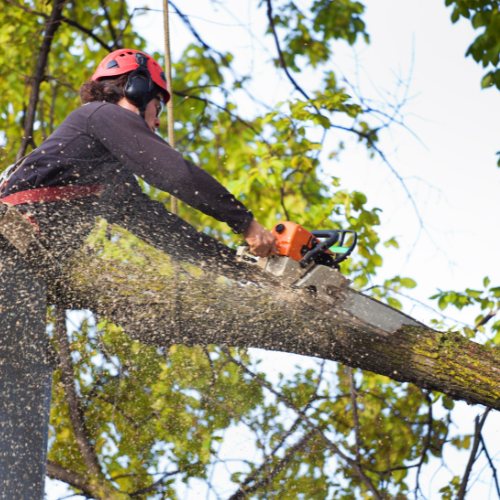
Tree worker in a bucket truck cutting a limb with a chainsaw

Tree services for Madison yards

From a single removal to routine tree care, five tree services cover nearly every call we get. Each has its own page covering how the work is done, the local rules that apply, and what the finished job should look like.

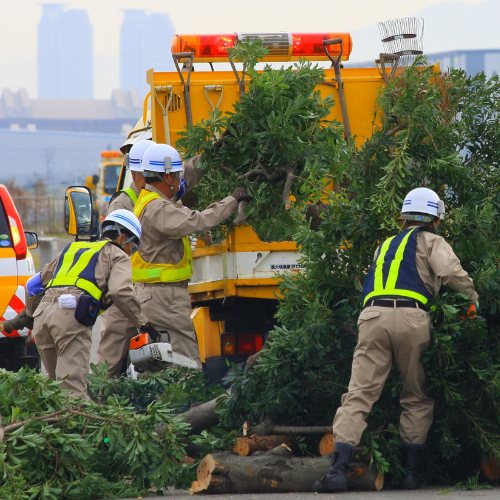
Crew in helmets and hi-vis vests clearing a felled tree beside a work truck

Tree Removal

Professional tree removal for dead, storm-damaged, leaning or badly placed trees. On tight lots around the isthmus and the near west side we climb and lower the tree in pieces on ropes, so nothing lands on the garage, the fence or the neighbor’s landscaping. Open suburban yards often allow a faster, simpler takedown. Ash trees killed by emerald ash borer turn brittle quickly, which changes how they have to be rigged. Our tree removal services include chipping, hauling and a raked yard.

In Madison: before we quote, we check whether the trunk stands on your lot or in the City’s terrace, and whether it’s an oak inside the April 1 to October 15 permit window.

Tree removal in Madison
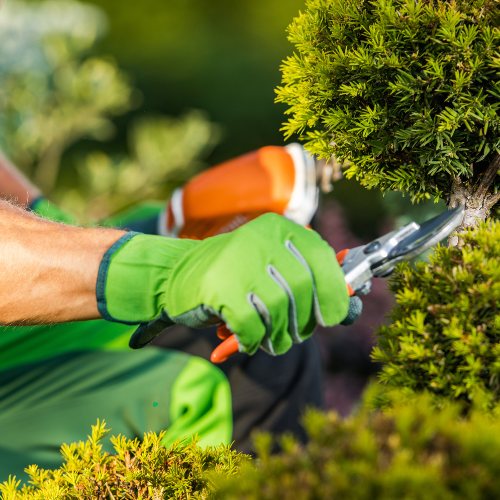
Gloved hands pruning an evergreen shrub with hand pruners

Tree Trimming & Pruning

Professional tree trimming and tree pruning to the ANSI A300 standard: no topping, no lion-tailing, and no climbing spikes on a tree that’s staying. Our skilled arborists prune for roof and driveway clearance, deadwood over play areas, storm-damaged limbs, and good structure in young trees, which is the most valuable tree care a young tree ever gets. We would rather make a few correct cuts than a lot of fast ones. Healthy trees are built by what you leave on.

In Madison: most tree pruning is best done while trees are dormant. For oaks inside city limits, dormant-season timing is the law, not a preference.

Tree trimming in Madison
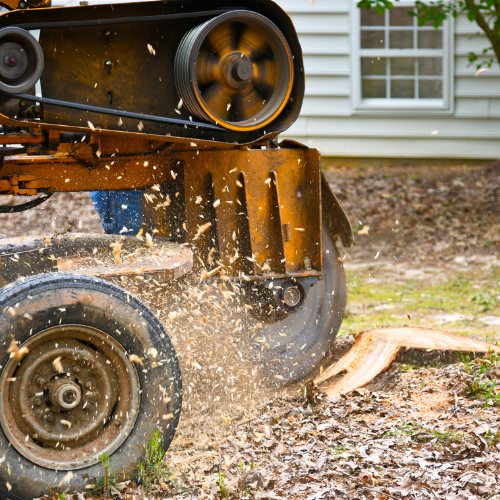
Stump grinder wheel throwing wood chips as it grinds a stump near a house

Stump Grinding

We grind the tree stump 6 to 8 inches below grade, deeper where you plan on planting, then rake the chips back into the hole or haul them off. The spot is left ready for topsoil and seed, a new bed or other landscaping. Surface roots can be chased out on request. Most residential stumps are a morning’s work, not a project.

In Wisconsin: state law requires a Diggers Hotline ticket three working days before anyone digs or grinds. We file it. The locate covers public utility lines only, so tell us about private ones: dog fences, irrigation, lighting, a gas line to the grill.

Stump grinding in Madison
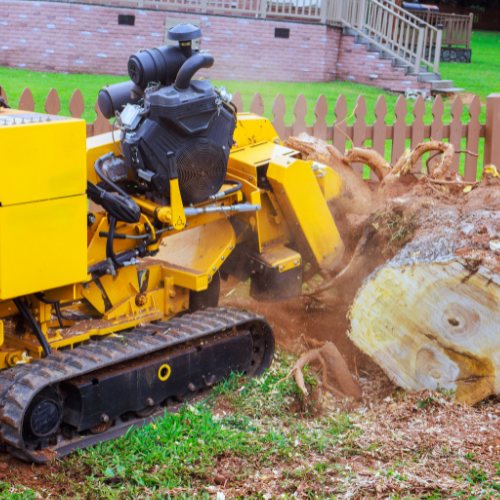
Tracked stump grinder working on a large uprooted stump beside a picket fence

Stump Removal

Full stump removal takes out the whole thing, main roots included, instead of grinding the top. It is a bigger job and leaves a bigger hole, so we recommend it only where buried wood causes trouble later: under a new driveway, patio, addition or fence line, or where a replacement tree is going in the same spot. Buried wood rots, and the ground above it settles. Every quote we write for one shows grinding and removal side by side.

Planting again? Shift the new hole a few feet off the old one, or have it pulled, roots and all, so young roots aren’t growing into sawdust.

Stump removal in Madison
Climber in a red helmet cutting a heavy limb with a chainsaw

Emergency Tree Service

Emergency tree removal for trees on houses, garages, cars and driveways, and for split trunks and hanging limbs after a storm. We make the site safe first, photograph the damage for your insurance claim, and write the invoice the way adjusters ask for it: getting the tree off the structure on one line, yard debris on another. Fallen trees tangled in wires wait for MGE. Nobody should cut near a line that hasn’t been cleared.

During storms we triage by hazard: trees on occupied homes first, then blocked driveways, then everything else. Call (608) 571-1326.

Emergency tree service in Madison

Four years that changed tree work in Madison

Count the rings in from the bark. Each marked year left a different kind of work behind, and a lot of it is still standing in somebody’s yard.

  • 2013Emerald ash borer is confirmed near Warner Park. Untreated ash have been dying since.
  • 2022A June windstorm does what MGE calls its worst damage in more than 30 years.
  • 2024The May 21 storm becomes the largest outage event in MGE’s recent history.
  • 2026Windstorms hit on April 14 and June 10. The second cuts power to more than 14,000 customers.

Madison has tree rules. We work inside them.

Urban tree management here is split in two. The City’s Urban Forestry crews look after street, park and greenway trees. Tree care in a private yard is the owner’s responsibility, and a few city ordinances still apply to it.

Oaks are off-limits from April 1 to October 15

City ordinance MGO 23.40(7) requires a free Urban Forestry permit for any work on an oak in the City of Madison between those dates, and that includes oaks on private property. The reason is oak wilt, a fatal tree disease carried by sap beetles that fly to fresh cuts. The Wisconsin DNR advises against pruning oaks from April through July anywhere in the state. We book oak pruning for winter and handle the permit when a storm-damaged oak can’t wait.

Sources: City of Madison, Oak Trees Work Permit and Wisconsin DNR, oak wilt guidance

The terrace tree isn’t yours to cut

The strip between the sidewalk and the street is public right-of-way, and the trees in it belong to the City. Urban Forestry prunes and removes them; nobody else may without a permit. On streets with no sidewalk, the right-of-way can reach 10 to 13 feet back from the pavement. If the trunk stands in your yard, the tree is yours. For private trees the City recommends contacting certified arborists and points residents to the Wisconsin Arborist Association.

Source: City of Madison, Private Property Trees

Ash trees: treat early or remove on schedule

Emerald ash borer was confirmed in Madison in late 2013, and the City now protects about 10,000 public ash trees with trunk injections. In a yard the decision is yours. A healthy ash can still be treated; that work belongs to a certified pesticide applicator, ideally an ISA Certified Arborist who can judge whether the tree is worth saving. A declining ash should come down while the wood is still sound enough to climb, because dead ash gets more brittle and more dangerous to work on every season.

Source: City of Madison, Emerald Ash Borer

Building near a street tree

Since January 1, 2026, Madison requires one foot of protected ground for every inch of trunk diameter around street trees on construction sites. If you’re planning a driveway, an addition or a backyard cottage, tree preservation belongs in the plan from day one. We can walk the lot with your contractor and flag which mature trees are worth designing around.

Source: City of Madison, Tree Protection Ordinances

Tree down? Who to call, in order.

After a storm, the first call isn’t always a tree service. This is the order that keeps people safe and keeps an insurance claim clean.

  1. Someone is hurt, a tree is on an occupied house, or wires are sparking

    Call 911.

  2. A tree or limb is on a power line, or a line is on the ground

    MGE, 608-252-7000. Stay well back and treat every wire as live.

  3. The tree came from the terrace, a park or a greenway

    City of Madison Urban Forestry, 608-266-4816. After hours: 608-255-2345.

  4. The tree came from your yard and is on your house, car, fence or driveway

    Tree Service Madison, (608) 571-1326. Our emergency tree services start with making it safe.

Worried about a neighbor’s tree that looks ready to fail? Talk to them first. If that goes nowhere, the City’s Building Inspection office takes reports about hazardous trees on private property at 608-266-4551.

How a job runs, start to finish

One stump or a full season of tree care, every job follows the same four steps.

  1. We walk the yard

    Free, in person. We look at species, condition, lean, what’s underneath, how equipment gets in, and whether the tree is yours or the City’s.

  2. You get it in writing

    An itemized quote with tree work, stump option, hauling and lawn protection on separate lines, so you can compare quotes line by line.

  3. We do the work

    Mats or plywood where machines cross the lawn, rigging where there’s anything to hit, chipper at the curb. Your landscaping should look the way it did before we came.

  4. We walk it again

    We don’t call it a great job until you have walked the yard with us and agreed.

The finished-job standard

What we check with you before the truck leaves.

  • Stump height or grind depth matches the quote
  • Brush, logs and sawdust gone, unless you kept them
  • Lawn raked, walks and driveway blown clean
  • Beds, fences, gutters and the neighbor’s side checked
  • Pruning cuts clean at the branch collar, no stubs
  • Gates latched, mats and cones picked up

Remove it, prune it, or leave it alone?

Most calls start with the same question. These are the signs we look for when we walk a yard, so you can read your own tree before anyone shows up with a saw.

Usually has to come down

  • The tree is dead, or more than half of the crown is.
  • An untreated ash that has lost about half its leaves to emerald ash borer.
  • A deep crack, or a hollow through a large part of the trunk.
  • A new lean, with soil lifting or cracking on the side opposite the lean.
  • Shelf fungus or mushrooms at the base, with branches dying back above.

Usually can be saved

  • Dead or broken branches in a crown that is otherwise full and green.
  • Limbs reaching over the roof or the driveway. Reduction cuts fix that; topping never does.
  • Twin trunks meeting in a tight V. Reduction pruning or tree cabling takes load off the weak union.
  • Storm damage that took less than about a quarter of the crown.
  • A healthy ash caught early, which a certified applicator can still treat.

Usually fine to leave

  • A steady lean the tree has always had, with no movement in the soil.
  • Small dead twigs deep inside the crown, shaded out by the leaves above.
  • Lichen or moss on the bark. Neither one harms the tree.
  • Surface roots in the lawn. Cover them with mulch; don’t cut them.
  • An old wound with thick, healthy wood rolled around its edges.

Can’t tell which column your tree belongs in? That is what the free on-site visit is for. Tree preservation comes first with us: a big shade tree takes decades to replace, and good tree care saves more of them than most people expect. For a close call on a large tree near a house, we will tell you to get a written risk assessment from one of the area’s certified arborists before anyone cuts.

Have us look at your tree

A year of tree care in Madison

Professional tree care is mostly timing. Wisconsin’s seasons decide when to prune, when to plant and when to leave a tree alone. This is the calendar we work by.

Winter

December to March

  • The best window for tree pruning: no leaves, no insects, frozen ground.
  • Oak work happens now, outside the City’s April 1 to October 15 permit window.
  • A good time to take down dead ash, with less damage to the lawn.

Spring

April and May

  • Tree planting season. Dig wide, not deep, and keep the root flare at grade.
  • Hold off on oaks. If a storm wounds one, seal the wound within minutes.
  • After the first big wind, walk the yard and look up for hangers and cracks.

Summer

June to August

  • Storm season. Broken limbs over roofs and driveways come first.
  • Oak leaves that bronze from the tips and drop in July are how oak wilt shows up.
  • Thin crowns, woodpecker damage and D-shaped holes in ash bark mean borers.
  • Water young trees deeply once a week in dry spells. Tree health in the first three years decides the next fifty.

Fall

September to November

  • The second planting window, and often the better one: warm soil, cool air.
  • Mulch 2 to 4 inches deep and pull it back from the trunk. No volcanoes.
  • After leaf drop, structure shows again. Plan winter pruning for mature trees now.

Not every problem tree needs to come down. Good tree care often means doing less: crown reduction, deadwood removal or tree cabling by a qualified arborist can keep a sound tree standing for decades, and we will say so when that is the better answer. Certified arborists work to the same rule of thumb we do: never take more than about a quarter of a living crown in one season.

Where we work

Service area mapSchematic map of Dane County showing our shop on the Beltline in southwest Madison and the communities we serve: Fitchburg, Verona, Middleton, Monona, McFarland, Sun Prairie, Waunakee, Oregon, Cottage Grove, DeForest, Windsor, Stoughton, Mount Horeb, Cross Plains, Shorewood Hills and Maple Bluff.Beltline (US 12/18)Lake MendotaMadisonFitchburgVeronaMiddletonMononaMcFarlandSun PrairieWaunakeeOregonCottage GroveDeForestWindsorStoughtonMount HorebCross PlainsShorewood HillsMaple BluffOur shop
Schematic map. Filled dots are the communities we visit most often.

Our shop is at 4269 W Beltline Hwy, just off Seminole Highway on Madison’s southwest side. That puts Nakoma, Orchard Ridge, Midvale Heights, Meadowood and Dunn’s Marsh a few minutes away, with Fitchburg and Verona right behind them. As a local tree care service we cover the whole city and the Dane County communities around it.

Madison neighborhoods

  • West and southwest: Nakoma, Westmorland, Midvale Heights, Orchard Ridge, Meadowood
  • Near west: University Heights, Regent, Vilas, Dudgeon-Monroe
  • Isthmus and downtown: Tenney-Lapham, Marquette, Mansion Hill
  • East side: Schenk-Atwood, Eastmorland, Lake Edge
  • North side: Sherman, Warner Park, Cherokee
  • South side: Bay Creek, Arbor Hills, Leopold

Around Dane County

Also Waunakee, Oregon, Cottage Grove, DeForest, Windsor, Stoughton, Mount Horeb, Cross Plains, Shorewood Hills and Maple Bluff. Every municipality handles street and terrace trees its own way, so we check the local rule before we cut. See all service areas.

Who you’re hiring

Quincy Carroll, founder of Tree Service Madison
Quincy CarrollFounder

Tree care is simple to describe and easy to get wrong: the wrong cut on an oak in June, a stump ground over a gas line, a rushed removal that ends with a crushed fence and no paperwork. I built this company around avoiding those outcomes.

You get a written quote you can compare line by line, a crew that protects the lawn it crosses, and a straight answer when a tree doesn’t need to come down. Some of our best calls end with us recommending a little pruning, or nothing at all. When a job calls for a diagnosis or a written risk assessment, we will tell you to get an arborist’s written opinion rather than guess.

Quincy Carroll, founder · More about the company

Questions Madison homeowners ask

Do I need a permit to remove a tree in Madison?

Not for most trees in your own yard. You do need a free City permit to work on any oak between April 1 and October 15, and you can’t touch terrace trees between the sidewalk and the street, because those belong to the City. We check all three before quoting.

When can oak trees be pruned in Madison?

From October 16 through March 31 without a permit. From April 1 to October 15 a City ordinance requires a free Urban Forestry permit for any oak work, because fresh cuts attract the beetles that spread oak wilt. Storm-damaged oaks can be permitted on an emergency basis.

Who takes care of the tree between my sidewalk and the street?

The City of Madison. Terrace trees are public, and Urban Forestry prunes and removes them. Report a problem at 608-266-4816. Private crews, ours included, can’t work on a terrace tree without a City permit.

Does homeowners insurance cover a fallen tree?

Often, when the tree damages a covered structure such as your house, garage or fence; taking it off that structure is usually part of the claim. A tree that falls and hits nothing is generally not covered. Policies differ, so call your insurer before work starts. We document the damage for them.

A tree fell on my house. What do I do first?

Get everyone out of the damaged rooms and call 911 if anyone is hurt or wires are down. Then call your insurer and a tree service. Take photos before anything moves. We clear the tree from the structure first and bill it separately from yard debris.

Stump grinding or stump removal: which do I need?

Grinding suits lawns and planting beds: the wood is chipped 6 to 8 inches below grade and the roots decay in place. Full removal pulls everything, main roots included, and makes sense under new concrete, footings or fence lines. We quote both.

When do I need a certified arborist instead of a tree service?

For removals, pruning and routine tree care, hire an insured, experienced crew. ISA Certified Arborists are the right call for diagnosing tree disease, written risk assessments and treatment plans; verify the credential at treesaregood.org. Wisconsin has no state license for tree work.

Do you haul everything away?

Yes, unless you want it. Brush is chipped, logs are hauled, and the lawn is raked and blown clean. Want wood chips for mulch, or firewood-length rounds stacked by the driveway? Say so at the estimate and we will write it into your quote.

More questions and answers

Request a free estimate

Tell us what you’re looking at and we’ll call to set a time to walk the yard. If a tree is down or hanging, call instead.

Tree Service Madison
4269 W Beltline Hwy, 1st Floor
Madison, WI 53711
Monday to Saturday, 7am to 6pm
Storm calls are triaged by hazard.

We use these details to reply to your request and for nothing else. Privacy policy.

Call (608) 571-1326 Free estimate