Tree work across Madison and Dane County, from our shop on the Beltline

Mon–Sat 7am–6pm (608) 571-1326

Tree Trimming & Pruning in Madison, WI

Deadwood over the driveway, limbs on the roof, a young tree growing two trunks: careful tree trimming and pruning fixes them without hurting the tree. We prune to the ANSI A300 standard, and we do not top trees.

  • No topping, ever
  • No climbing spikes on live trees
  • Oaks pruned only in season
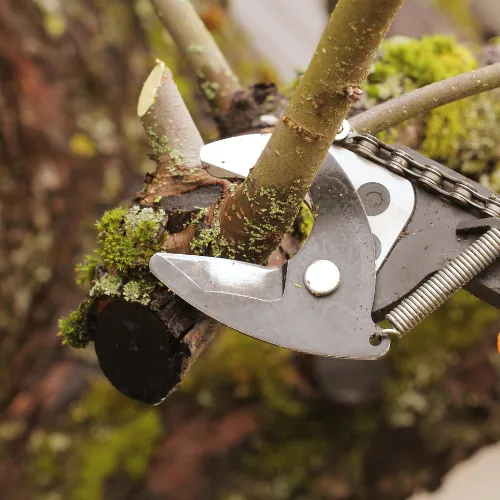
Pruning tool making a clean cut through a small tree branch

Good pruning is mostly about what stays

People say tree trimming, arborists say tree pruning, and both mean the same job: removing the right branches, in the right place, at the right time of year, and leaving everything else alone.

A tree cannot heal a cut the way skin does. It walls the wound off and grows around it, which takes energy and leaves a weak point for years. That is why professional tree trimming is judged by how few cuts it took, not by the size of the brush pile. Every branch we remove has to earn its removal by doing one of four things:

  • Making the tree safer: dead, cracked, hanging and rubbing branches come out before a storm takes them out for you.
  • Making room: clearance over the roof, the driveway, the sidewalk and the street, and away from siding, gutters and the service wire.
  • Protecting tree health: removing diseased or dying wood and opening crowded branches so the rest of the crown gets light and air.
  • Building structure: guiding a young tree toward one strong trunk and well-spaced limbs, so it never develops the defects that bring mature trees down.

What we leave matters more. Healthy trees are built by the leaves you keep, and no pruning visit should take more than about a quarter of a tree’s living crown. If someone proposes more than that, they are selling a haircut, not tree care.

The pruning work we do

Your quote names the kind of pruning and the goal for each tree, in plain words, so you know what you are agreeing to.

Crown cleaning

Dead, dying, broken and crossing branches are removed throughout the crown. It is the most common pruning visit, and the one that does the most for safety. On mature trees over a house or a play area, deadwood is the first thing we look for.

Clearance pruning

Lower limbs are raised over driveways, walks and the street, and branches are pulled back from roofs, siding, chimneys and gutters. Limbs that rub shingles wear through them, and leaves packed against siding hold moisture. A few well-placed cuts solve it for years.

Crown reduction

Long, heavy limbs are shortened back to strong side branches to take weight off weak unions and reduce the sail a storm can push on. This is the correct alternative to topping. It keeps the tree’s natural shape and does not set off a flush of weak sprouts.

Structural pruning for young trees

In a tree’s first ten to fifteen years, a few small cuts every couple of seasons decide its whole future: one dominant trunk, no tight V-shaped forks, limbs spaced up the stem. It is the most valuable tree care a young tree ever gets, and the cuts are small enough to seal in a season.

Storm-damage repair

Torn and broken limbs are cut back cleanly to sound wood so the tree can seal the wound, and the remaining crown is rebalanced. A tree that lost less than about a quarter of its crown usually recovers well. Urgent cases go through our emergency tree service.

Ornamentals, evergreens and large shrubs

Crabapples, serviceberries, Japanese tree lilacs, arborvitae, yews and overgrown shrubs are thinned and shaped by hand. Most evergreens will not resprout from bare wood, so they get light shaping, never a hard cut.

What we won’t do, and why

The ANSI A300 pruning standard exists because the wrong cuts shorten a tree’s life. Our skilled arborists follow it on every job, which rules out a few things you may be offered elsewhere.

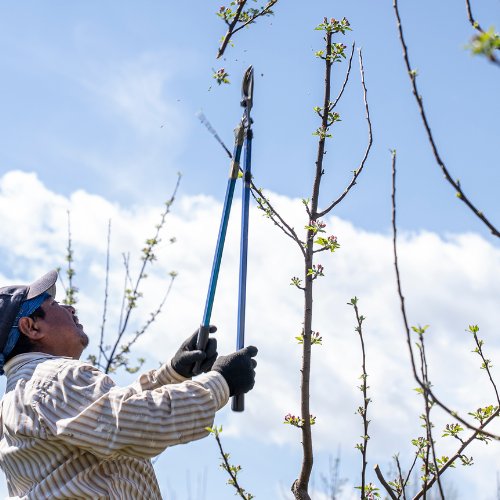
Person pruning a young tree with long-handled loppers under a blue sky
Small, well-placed cuts, made from the ground or on ropes. Never spikes on a tree that is staying.

Topping. Cutting the top off a tree removes the leaves it feeds itself with and leaves large stubs that rot. The tree answers with a thicket of fast, weakly attached sprouts, so within a few years it is taller and more dangerous than before.

Lion-tailing. Stripping the inner branches and leaving a tuft at the end of each limb shifts all the weight to the tips, which is exactly where wind has the most leverage.

Climbing spikes on a tree that is staying. Spikes punch a line of wounds up the trunk. We climb on ropes, or work from a lift. Spikes are for removals only.

Flush cuts and stubs. A cut flush to the trunk removes the branch collar, the tissue the tree uses to seal the wound. A long stub cannot be sealed at all. The correct cut sits just outside the collar.

Wound paint, with one exception. Sealants do not help most wounds and can trap moisture. The exception is an oak wounded during the growing season: that cut is sealed immediately, because oak wilt is a tree disease carried by beetles that find fresh oak wounds within minutes.

When to prune in Madison

Wisconsin’s seasons set the schedule. Most tree pruning is best done while trees are dormant, and for oaks inside city limits the calendar is law, not preference.

TreeBest timeWhy
OaksOctober 16 to March 31From April 1 to October 15 the City of Madison requires a free permit for any oak work, and the Wisconsin DNR advises against pruning oaks from April through July anywhere in the state. The beetles that spread oak wilt are not flying in the cold months.
ElmsLate fall and winterFresh cuts in the growing season attract the bark beetles that carry Dutch elm disease.
Maples, birches, walnutsMid-summer or early winterCut in late winter, they run sap heavily. It looks alarming and is harmless, but it is easy to avoid.
Crabapples, pears, hawthornsLate winter, fully dormantDormant cuts limit the spread of fire blight, which moves on tools and in wet spring weather.
Honeylocust, linden and most shade treesLate fall through winterThe bare crown is easy to read, insects and fungi are inactive, and frozen ground protects the lawn from equipment.
Spruce, pine, arborvitae, yewLate winter, or early summer after new growthLight shaping only. Most evergreens cannot regrow from old, bare wood.
Dead, broken or hanging limbsAny day of the yearA hazard does not follow a calendar. On oaks in season, we get the emergency permit and seal the wound.

The oak rules are covered in full in our guide to oak wilt and the oak work permit.

How a pruning visit works

  1. Agree on the goal

    We walk the yard with you and name the goal for each tree: deadwood, roof clearance, a lighter limb over the garage. The goal goes on the written quote.

  2. Climb on ropes, not spikes

    Our climbers work from ropes and harnesses, or from a lift where a tree can’t be climbed safely. Cut limbs over anything fragile are lowered on a line.

  3. Make few, correct cuts

    Each cut lands just outside the branch collar, back to a side branch big enough to take over. No stubs, no flush cuts, no more than a quarter of the crown.

  4. Clean up and walk it

    Brush is chipped, the lawn is raked, hard surfaces are blown clean, and we look up at each tree with you before we leave.

Terrace trees, neighbors and power lines

Terrace trees. A tree between the sidewalk and the street belongs to the City of Madison, and only Urban Forestry may prune it. If its limbs are low, dead or on your roof, report it at 608-266-4816. Our guide to terrace trees explains who does what.

Neighbors. Overhanging branches are the most common boundary question we hear. Cutting back to the property line from your own side is generally allowed, provided the tree is not harmed, but a one-sided trim often leaves an unbalanced tree. When both owners agree, pruning the whole tree properly is better for everyone, including the tree.

Power lines. We prune around the insulated service wire that runs to your house. The bare primary lines along the street or the back lot line are MGE’s: call 608-252-1111 about trees growing into them, and never prune near those lines yourself.

When pruning is no longer enough, we will say so plainly and explain why. That conversation is on our tree removal page.

Tree trimming questions from Madison homeowners

How often should trees be pruned?

Young trees every two to three years while their structure forms. Mature shade trees every three to five years, or sooner if deadwood builds up or limbs reach the roof. Fast growers such as silver maple and willow need attention more often than oaks.

Can you prune oak trees in summer?

Inside the City of Madison, only with a free Urban Forestry permit, because pruning oaks from April 1 to October 15 risks oak wilt. Storm-broken limbs are the exception: they are permitted on an emergency basis and the wounds are sealed right away.

Is topping ever a good idea?

No. Topping strips the leaves a tree feeds itself with, lets decay into large stubs, and triggers fast, weakly attached sprouts that are more dangerous than the limbs they replaced. Crown reduction back to proper side branches lowers a tree without that damage.

Can I trim branches from my neighbor’s tree?

In Wisconsin you can generally cut back branches that hang over your side, up to the property line and from your own side, as long as you don’t harm the tree’s health. Talk to your neighbor first. If you both agree, we can prune the whole tree properly in one visit.

Will pruning hurt my tree?

Every cut is a wound, so good pruning makes as few as possible and places them at the branch collar, where the tree seals them fastest. Done that way, and kept under about a quarter of the live crown, pruning makes a tree safer and longer-lived.

Do you trim hedges, shrubs and ornamental trees?

Yes. Ornamental trees, arborvitae, yews and overgrown shrubs can be handled in the same visit as your shade trees. Tell us what you would like shaped or reduced when you request the estimate.

Request a free estimate

Tell us what you’re looking at and we’ll call to set a time to walk the yard. If a tree is down or hanging, call instead.

Tree Service Madison
4269 W Beltline Hwy, 1st Floor
Madison, WI 53711
Monday to Saturday, 7am to 6pm
Storm calls are triaged by hazard.

We use these details to reply to your request and for nothing else. Privacy policy.

Call (608) 571-1326 Free estimate