Tree work across Madison and Dane County, from our shop on the Beltline

Mon–Sat 7am–6pm (608) 571-1326

Tree Removal in Madison, WI

Dead, storm-damaged, leaning or simply in the wrong place: we take trees down safely on tight city lots and open suburban yards, and we check Madison’s tree rules before a saw starts.

  • Free on-site estimates
  • Itemized quotes in writing
  • Proof of insurance on request
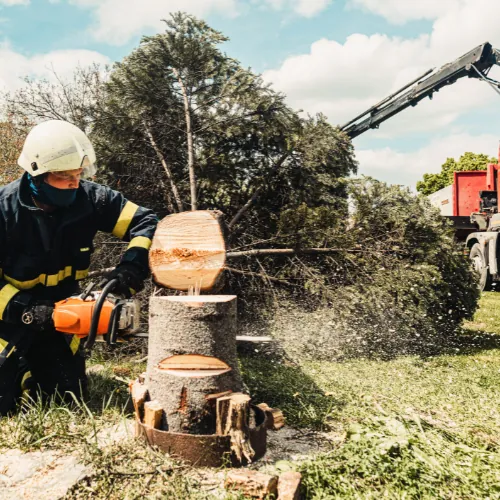
Worker in a helmet cutting a tree trunk into sections with a chainsaw, with a crane truck behind

When a tree has to come down

Tree removal is the last tool we reach for, not the first. A sound tree is worth keeping, and plenty of worrying trees only need pruning. These are the situations where removal is the right call.

The tree is dead or dying. Dead wood dries out, loses its strength and starts dropping limbs without warning. The longer a dead tree stands, the fewer safe ways there are to take it down, because a climber can no longer trust it to hold a rope.

The structure has failed. A deep crack in the trunk, a cavity through much of the stem, two trunks splitting apart at a tight fork, or a new lean with the soil lifting behind it all mean the tree can no longer carry its own weight in a storm.

It is an untreated ash. Emerald ash borer has been in Madison since 2013, and an ash that was never treated is on borrowed time. Once about half the crown is gone, treatment no longer works and the wood turns brittle quickly.

Storm damage took too much. A tree that has lost most of its crown, or whose main trunk has split, rarely grows back into a safe tree. After the windstorms of 2022, 2024 and 2026, a lot of Madison yards still hold trees in this condition.

It is in the wrong place. Roots lifting a foundation or crowding a sewer lateral, a trunk pressing on a garage, a volunteer tree growing up through the service wires, or a healthy tree standing exactly where an addition is going.

Not sure it has to go? That is the most common call we get. We would rather prune a good tree than remove it, so have a look at tree trimming and pruning first. For a close call on a large tree near the house, a written risk assessment from one of the area’s certified arborists is the right next step, and we will tell you so.

How we take a tree down

The method depends on what is underneath the tree and how far the wood can still be trusted. Professional tree removal is mostly planning: where each piece lands is decided before the first cut.

Felling in one piece

Where there is open ground at least as long as the tree is tall, with nothing to hit, we notch the trunk and lay the whole tree down along a planned line. It is the quickest method and the easiest on the lawn, and it is common on the larger lots in Fitchburg, Verona and the newer parts of the far west side.

Taking it apart from the top

Most Madison removals are not like that. On the isthmus, the near west side and the older east side, trees stand between houses, garages, fences and wires. A climber goes up on ropes, removes the limbs one at a time and lowers each piece on a rigging line controlled from the ground, then brings the trunk down in short sections. Nothing free-falls, so nothing lands on the garage roof or the neighbor’s landscaping.

When the tree can’t be climbed

Dead ash trees, storm-split trunks and trees with heavy decay may not be safe to climb or to rig from. Those come down from a lift, or are lifted out in pieces by a crane, so that nobody’s weight depends on wood that might fail. We will tell you at the estimate if your tree is one of these, and why.

How every job is run

Every job is run to the ANSI Z133 safety standard for tree work: helmets, eye and hearing protection, saw-resistant leg protection, a marked drop zone, and a ground crew whose job is to keep people and pets out of it.

Madison rules we check before any removal

Most private trees in Madison can be removed without a permit. The exceptions matter, and checking them is part of our estimate, not your homework.

Is the tree actually yours?

If the trunk stands between the sidewalk and the street, it is a City terrace tree. On streets without sidewalks the public right-of-way can run 10 to 13 feet back from the pavement, so a tree that looks like yours may not be. Only Urban Forestry can remove it: call 608-266-4816. We check the lot lines before we quote. More in our guide to terrace trees in Madison.

Oaks: April 1 to October 15

Under City ordinance MGO 23.40(7), any work on an oak inside the City of Madison between those dates needs a free permit from Urban Forestry, on private property too. Fresh oak cuts attract the beetles that spread oak wilt. We schedule oak removals for the cold months whenever the tree can safely wait, and apply for the permit when it cannot. See oak wilt and the oak work permit.

Ash trees and emerald ash borer

The City protects roughly 10,000 public ash trees with trunk injections. Private ash trees are the owner’s decision. If yours was never treated and the crown is thinning, plan the removal now. Dead ash gets too brittle to climb, which narrows the safe ways to bring it down and makes every season of waiting harder on the crew and the yard.

Trees on the lot line

If the trunk straddles the property line, treat the tree as shared and get your neighbor’s agreement in writing before anything is cut. For a neighbor’s tree that looks hazardous and an owner who will not act, the City’s Building Inspection office takes reports at 608-266-4551.

The full picture is in our guide to tree removal permits in Madison.

What happens on removal day

Six steps, the same on a small ornamental as on a big silver maple over a garage.

  1. Walk the site together

    We confirm which trees go and which stay, where the truck and chipper park, and anything fragile underneath: a new patio, a vegetable bed, a playset.

  2. Protect what’s underneath

    Mats or plywood go down where equipment crosses the lawn. Planters and furniture move out of the way, and the air conditioner and window wells get covered if they are close.

  3. Set the drop zone

    Cones and rope mark the area where pieces will land. If limbs hang over the neighbor’s side, we knock on their door first.

  4. Bring the tree down

    Felled in one piece where there is room, or taken apart from the top and lowered on ropes where there is not.

  5. Chip, cut and haul

    Brush goes through the chipper. Trunk wood is cut to length and loaded, or stacked where you want it if you are keeping it.

  6. Walk it again

    The stump is cut low, the yard is raked, hard surfaces are blown clean, and we walk the site with you before the truck leaves.

What our tree removal services include

On every job

Written into the quote, so there is nothing to argue about later.

  • Brush chipped and hauled away
  • Logs hauled, or cut to firewood length and stacked
  • Stump cut as low as the saw safely allows
  • Lawn raked, walks, driveway and street blown clean
  • Beds, fences, gutters and the neighbor’s side checked
  • Photos of the finished site for insurance claims
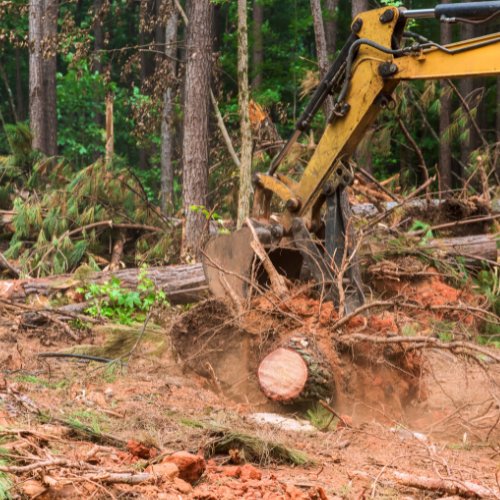
Excavator pulling a tree stump and its roots out of cleared ground
Once the tree is down, the stump can be ground below grade or taken out completely.

After the tree is gone

A removal leaves a stump, and you have three choices: leave it, grind it, or take it out completely. Stump grinding is right for lawns and planting beds. Full stump removal is for places where buried wood would cause trouble later, such as under new concrete, a footing or a fence line. Either can be done the same day as the removal or booked later.

If you plan on planting a replacement, set the new tree several feet away from the old stump and pick a species that fits the space when it is fully grown. Look up for wires and out toward the house before you choose. Madison lost much of its ash canopy in about a decade, and a yard with a mix of species is how you avoid the same thing happening twice. If the tree you lost stood on the terrace, replanting it is the City’s job; ask Urban Forestry.

Storm damage that can’t wait for a scheduled visit is handled through our emergency tree service.

Tree removal questions from Madison homeowners

Do I need a permit to remove a tree in Madison?

Not for most trees in your own yard. You do need a free City permit for any work on an oak between April 1 and October 15, and terrace trees between the sidewalk and the street belong to the City, so only Urban Forestry can remove those. We check both before we quote.

Can you remove a tree that is close to my house or over wires?

Yes. Tight removals are taken apart from the top and lowered on ropes, so nothing free-falls. We work around the service line to your house. Anything touching MGE’s primary lines has to be cleared by MGE first; their power line number is 608-252-1111.

How long does a tree removal take?

Most single trees are down and cleaned up the same day. Very large trees, several trees at once, or removals that need a lift or a crane can run longer. You get the expected schedule in writing with your quote.

Will the work damage my lawn?

We lay mats or plywood where equipment crosses, lower pieces on ropes instead of dropping them, and rake out any ruts before we leave. Frozen winter ground is the gentlest time for heavy removals, which is one reason we like cold-season work.

Can I keep the wood or the chips?

Yes. Tell us at the estimate. Logs can be cut to firewood length and stacked, and wood chips make good mulch for beds and paths. If the tree was an ash, keep the firewood local: moving it is how emerald ash borer spreads.

My neighbor’s dead tree leans over my yard. What can I do?

Start with a conversation, and put your concern in writing so there is a record. You can generally trim what overhangs your side. If the owner won’t act on a tree that looks dangerous, the City’s Building Inspection office takes reports at 608-266-4551.

Do you remove trees in winter?

Yes, and for many jobs it is the best time. The ground is frozen, the crown is bare and easy to read, and oaks can be cut without a City permit from October 16 through March 31.

Request a free estimate

Tell us what you’re looking at and we’ll call to set a time to walk the yard. If a tree is down or hanging, call instead.

Tree Service Madison
4269 W Beltline Hwy, 1st Floor
Madison, WI 53711
Monday to Saturday, 7am to 6pm
Storm calls are triaged by hazard.

We use these details to reply to your request and for nothing else. Privacy policy.

Call (608) 571-1326 Free estimate