Tree work across Madison and Dane County, from our shop on the Beltline

Mon–Sat 7am–6pm (608) 571-1326

Emergency Tree Service in Madison, WI

A tree on the house, the car or the driveway, a split trunk, a limb hanging over the front walk: call us. We make it safe first, document the damage for your insurer, and clean up after.

  • Trees on occupied homes come first
  • Damage photographed for your insurer
  • Wires down? MGE goes first
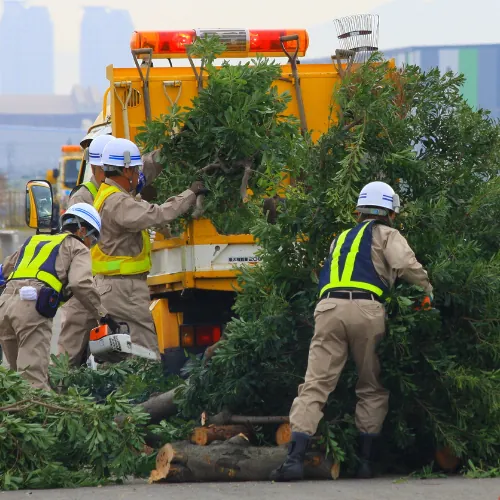
Crew in helmets and hi-vis vests clearing a fallen tree from a road beside a work truck

First, make sure everyone is safe

The tree has already fallen. Nothing about it will get worse in the next ten minutes, but people get hurt in those minutes by going to look. Do these in order.

  1. Get people out and away

    Leave the damaged rooms. Keep children, pets and curious neighbors well back from the tree, the crater and anything it is leaning on.

  2. Look for wires, from a distance

    Treat every line on the ground, in the tree or on a car as live. If anyone is hurt, a line is sparking, or you smell gas, leave and call 911.

  3. Don’t go under it or onto it

    Fallen trees shift. Broken limbs hang in the crown and drop without warning. Stay off the roof and out from under the trunk.

  4. Take photos before anything moves

    Wide shots of the whole scene, then close-ups of each point of damage, all from a safe spot. Your insurer will ask for them.

  5. Call your insurer

    Open the claim and ask what they need before work starts. Acting to prevent further damage is normally expected of you.

  6. Call us

    (608) 571-1326. Tell us what the tree is resting on, whether wires are involved, and whether anyone is blocked in.

Who to call, in order

The first call after a storm is not always a tree service. This order keeps people safe and keeps an insurance claim clean.

  1. Someone is hurt, a tree is on an occupied house, wires are sparking, or you smell gas

    Call 911.

  2. A tree or limb is on a power line, or a line is on the ground

    MGE, 608-252-7000. Stay well back and treat every wire as live.

  3. The tree came from the terrace, a park or a greenway

    City of Madison Urban Forestry, 608-266-4816. After hours: 608-255-2345.

  4. The tree came from your yard and is on your house, car, fence or driveway

    Tree Service Madison, (608) 571-1326. Our emergency tree services start with making it safe.

What counts as a tree emergency

During a storm we sort calls by hazard, not by the order they came in. Knowing which group you are in helps both of us.

Call now

  • A tree or large limb is on a house, a garage or a car.
  • A tree blocks your only driveway or way out.
  • A broken limb hangs over a door, a walk, a driveway or a play area.
  • A trunk has split and is still standing.
  • A tree near a building has started to lean, with soil lifting at its base.

Call today

  • Large broken limbs are caught in the crown, away from where people walk.
  • A tree is down across the yard or the fence, but not on a building.
  • An oak has torn limbs between April and October. Those wounds need sealing quickly.
  • Fallen trees are blocking a gate, a side yard or access you need this week.

Can wait for a scheduled visit

  • Small branches and twigs are down across the lawn.
  • A tree is down in a back corner, resting on nothing.
  • You want the rest of your trees checked after a storm.
  • The stump or root plate of a tree that has already been cleared.

How we work an emergency

Emergency tree removal is slower and more careful than ordinary tree work, not faster. The aim is to get the tree off without doing any more damage than the storm already did.

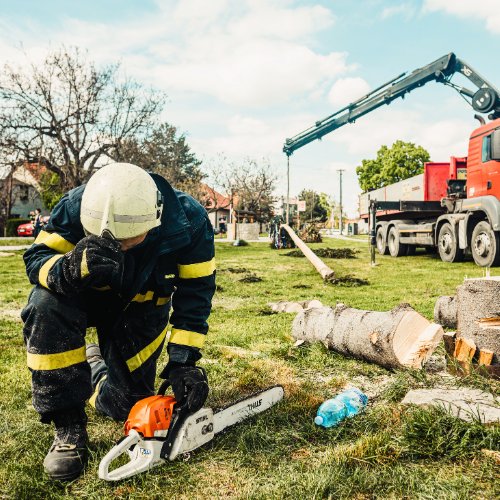
Worker in protective gear kneeling beside a chainsaw, with cut tree sections and a crane truck behind
Storm wood is under load. Every cut is planned around what the piece is holding up.

Make it safe

We start by looking, not cutting: wires, gas meters, what the tree is resting on, which limbs are broken and still hanging, and whether the roots have let go. A safe zone is marked, and nothing is cut until we know what each piece is holding up.

Why storm wood is different

A bent trunk or a limb pinned under weight stores energy like a drawn bow. Cut it in the wrong place and it splits, springs or rolls. Hung-up limbs fall when the tree below them moves, and an uprooted tree’s root plate can slam back into its hole the moment the trunk is cut free. This is why a storm is the worst possible time to learn to use a chainsaw.

Getting a tree off a building

The weight comes off in small pieces, from the outside in, lowered on ropes or lifted clear, so the tree never shifts and drags more roof with it. Once the load is off, your roofer or restoration company can close the opening.

Cleanup

Brush is chipped, wood is hauled and the yard is raked. The stump or root plate can be handled in the same visit or later: see stump grinding and stump removal.

Insurance: what adjusters ask for

We are tree people, not insurance people, and we do not interpret your policy. What we can do is make sure the tree side of your claim is documented the way adjusters want it.

  • Photos before anything moves. The whole scene first, then each point of damage. We take our own set as well, before, during and after the work.
  • A short written record. The date and time, what fell, what it hit, and the weather. Write it down the same day, while it is fresh.
  • An early call to your insurer. Ask whether they want to inspect before the tree is moved. When a tree is on a building, most insurers expect prompt action to stop further damage.
  • Paperwork that separates the work. Our invoice puts getting the tree off the structure on one line and clearing yard debris on another, because insurers usually treat the two differently.
  • The damaged items themselves. Keep broken fence panels, gutters and furniture until the adjuster has seen them or told you they don’t need to.

If the tree came from next door, or from the terrace, photograph the stump or the break as well. It shows where the tree stood and what condition it was in.

After the storm, and before the next one

June 2022. May 21, 2024. April 14 and June 10, 2026, when more than 14,000 MGE customers lost power. Severe wind is a regular visitor to Madison, and most of the trees that fail were showing signs first.

What can be saved

More than you might expect. A tree that kept most of its crown and has a sound trunk usually recovers, given proper corrective tree pruning: torn limbs cut back cleanly to sound wood and the crown rebalanced. Split forks can sometimes be supported with tree cabling by a qualified arborist. A split main trunk, a lifted root plate, or a crown that is mostly gone usually means tree removal. Storm-torn oaks get their wounds sealed immediately, and between April 1 and October 15 the City’s oak work permit is issued on an emergency basis.

Signs worth a look on a calm day

Any of these is a reason to book an ordinary estimate, long before it becomes an emergency.

  • Dead branches over the house, driveway or play area
  • Two trunks joined in a tight V, especially with a crack
  • A lean that is new, or soil lifting beside the trunk
  • Mushrooms or shelf fungus at the base
  • An untreated ash with a thinning crown
  • Long, heavy limbs reaching over the roof

A word about door-knockers

After every big storm, crews from out of the area work Madison neighborhoods door to door. Some are fine. Before you agree to anything, ask for a written quote, ask for a certificate of insurance sent to you by the insurer, not a photocopy, and check that the company has a local address you can visit. Ours is 4269 W Beltline Hwy. Anyone who pushes you to sign on the spot has told you what you need to know.

Emergency tree service questions

How fast can you get to me?

Call (608) 571-1326 as soon as it happens. During storms we triage by hazard: trees on occupied homes first, then blocked driveways, then everything else. Tell us what the tree is resting on and whether wires are involved, and we will tell you honestly where you stand.

A tree fell on a power line. Who do I call?

Call 911 if the line is sparking or lying on a car or building, then MGE at 608-252-7000. Stay well back and keep others away: a downed line can be live even when it is silent. No tree crew may touch the tree until MGE has made the line safe. Then we take over.

Will my homeowners insurance cover the tree work?

Often, when the tree damaged a covered structure such as the house, garage or fence. A tree that falls without hitting anything is generally not covered. Policies differ, so call your insurer early. We supply photos and paperwork that separate structure work from yard debris.

The tree came from my neighbor’s yard. Who is responsible?

In most cases your own policy responds to damage on your property, wherever the tree came from. It can be different if the owner had been warned the tree was dangerous and did nothing. That is a question for your insurer. Either way, the tree has to come off safely first.

A City terrace tree fell on my property. What now?

Report it to City of Madison Urban Forestry at 608-266-4816, or 608-255-2345 after hours. Terrace and park trees are the City’s to remove. If it is on your house or blocking you in, say so when you call. Photograph everything before it is moved.

Can a storm-damaged tree be saved?

Often. A tree that kept most of its crown and has a sound trunk usually recovers with proper corrective pruning, and split forks can sometimes be cabled by a qualified arborist. A split main trunk, a lifted root plate or a crown that is mostly gone usually means removal.

Request a free estimate

Tell us what you’re looking at and we’ll call to set a time to walk the yard. If a tree is down or hanging, call instead.

Tree Service Madison
4269 W Beltline Hwy, 1st Floor
Madison, WI 53711
Monday to Saturday, 7am to 6pm
Storm calls are triaged by hazard.

We use these details to reply to your request and for nothing else. Privacy policy.

Call (608) 571-1326 Free estimate