Tree work across Madison and Dane County, from our shop on the Beltline

Mon–Sat 7am–6pm (608) 571-1326

Stump Removal in Madison, WI

When grinding is not enough, we take out the whole tree stump and its main roots, backfill and compact the hole, and leave ground you can build on or plant in.

  • Stump and main roots out
  • Hole backfilled and compacted
  • Diggers Hotline ticket filed for you
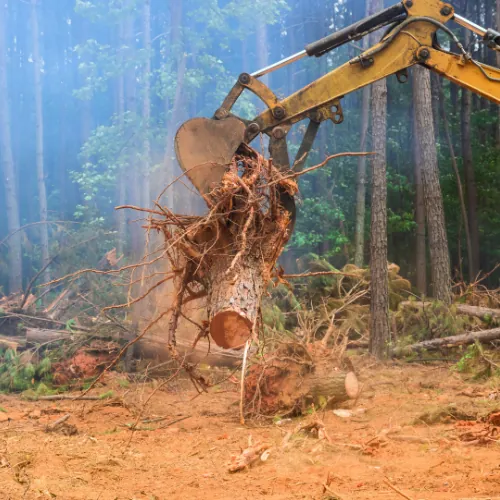
Excavator lifting a tree stump with its roots out of the ground

Grinding leaves the roots. Removal doesn’t.

Most stumps only need grinding, and we will tell you when yours is one of them. Full stump removal is the bigger job, and it is the right one in a handful of specific situations.

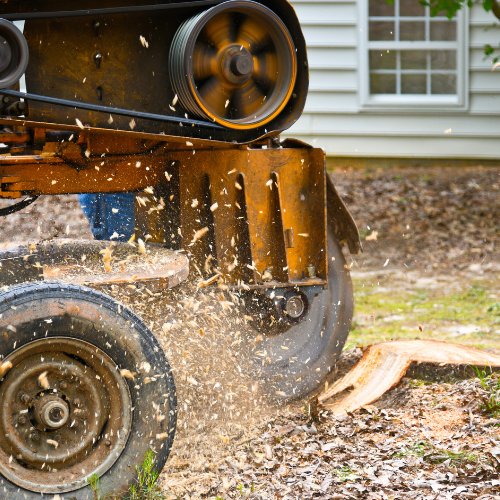
Stump grinder wheel throwing wood chips beside a house
Grinding, shown here, chips the stump away and leaves the roots. Fine under a lawn, not under concrete.

Stump grinding chips the stump away to below the lawn and leaves the roots in the ground to decay. Under grass, that is perfect. The trouble starts when something heavy or permanent goes on top. Buried wood rots, the rot leaves voids, and the ground above settles. A driveway cracks along the line of an old root. A paver patio develops a dip. A fence post leans. Full stump removal takes that wood out of the ground before it can cause any of this.

Stump removal is what we recommend when:

  • Concrete, asphalt or pavers are going over the spot: a driveway, a garage slab, a patio, a walk.
  • Something structural needs solid ground: footings for an addition or a deck, a shed pad, a retaining wall, a run of fence posts.
  • A new tree is going in the same place. Young roots do poorly in a pocket of sawdust and rotting wood. Clean soil gives a replacement tree a fair start.
  • You are building garden beds and want deep, workable soil without old roots stopping the spade.
  • A storm tipped the tree over and the whole root plate is already out of the ground. More on that below.

If none of those apply, grind it. It is easier on your lawn, and we would rather do the smaller job properly than sell you the larger one. Every stump quote we write shows both options side by side, so you can see exactly what each involves.

How a stump comes out

Pulling a stump with a chain and a truck belongs in old home movies. It tears up lawns, breaks things underground and rarely works. This is how professional stump removal is done.

Expose

We dig around the stump to uncover the main roots, by machine where there is room and by hand where there is not, such as beside a foundation or inside a fenced yard with a narrow gate. The soil is piled on a tarp or plywood, not on your grass.

Cut

Each main root is cut cleanly a set distance from the stump. Roots that run under a walk, a driveway or toward the house are cut at the edge and left where they are, because pulling them would lift whatever sits on top.

Lift and haul

Freed from its roots, the stump is rolled or lifted out and loaded. A mature stump with its root flare is extremely heavy, so the route to the truck is planned, and protected with mats, before anything moves.

Backfill in layers

The hole is refilled a layer at a time and each layer is compacted, because loose fill dumped in all at once will sink for years. Lawn areas are finished with topsoil, slightly mounded to allow for settling. If concrete or a footing is going in, tell us what your contractor needs and we will leave the hole at that stage.

Before anyone digs

Removing a stump is excavation, and excavation in a city yard has rules. These are checked before the quote is final.

The utility locate

Wisconsin law (Wis. Stat. 182.0175) requires a Diggers Hotline ticket at least three working days before any digging. We file it. Marked lines get a hand-dug margin of 18 inches on either side, and if a gas or electric line runs through the root zone, the plan changes to suit it.

Private lines nobody marks

The locate covers public utilities only. Invisible dog fences, irrigation, landscape lighting, a gas line to the grill, power to the garage, and sump or downspout drains are yours, and only you know where they run. Old trees and old pipes are often closer together than anyone remembers.

Foundations, walks and driveways

Roots do not stop at the edge of a slab. We look at where each main root goes before cutting it, and where one disappears under concrete we cut it and leave it. Sometimes the honest answer is that grinding is the safer choice next to a structure, and we will say so.

The terrace is off limits

The strip between the sidewalk and the street is City right-of-way. A stump there belongs to the City of Madison, and Urban Forestry handles it on the City’s schedule: report it at 608-266-4816. We dig on private property only. Our terrace tree guide explains where the line usually falls.

Storm-uprooted trees and root plates

Madison’s recent windstorms tipped over a lot of mature trees whole, leaving a wall of roots and soil standing on edge beside a crater.

That wall is called a root plate, and it is the one kind of stump job that starts out dangerous. The weight of the fallen trunk is the only thing holding the plate up. When the trunk is cut free, the plate can drop back into its hole in an instant, with enough force to crush anyone standing in the crater or behind it. Please keep children and pets away from an uprooted tree, and do not cut the trunk yourself.

We secure or lower the plate in a controlled way as the trunk comes off, then deal with it as a stump. Because the roots are already torn out of the ground, this is usually the simplest full removal there is: the plate is cut down and hauled, the torn roots are trimmed back, and the crater is backfilled and compacted. If the tree is on a building, a car or a driveway, start with our emergency tree service.

Fallen trees from the terrace are the City’s, root plate included. Call Urban Forestry at 608-266-4816, or 608-255-2345 after hours.

What you are left with

When we leave, there is no stump, no open hole and no pile of roots. Lawn areas are graded, topped with soil and ready for seed. Expect a little settling over the first year, even with careful compaction, and keep a bag of topsoil handy to top it up. Construction areas are left at the stage your contractor asked for.

Planting again

With the old wood gone, a replacement tree can go in the same spot, in fresh soil. Dig the planting hole wide and shallow, set the root flare level with the ground, and water deeply once a week through the first few summers. Fall and spring are the planting seasons in Wisconsin. Choose a species that fits the space when it is fully grown, and if the tree you lost was an ash, plant something else: a yard with a mix of species is the best protection against the next pest. For the landscaping around it, mulch 2 to 4 inches deep and keep it pulled back from the trunk.

Removal or grinding: a quick way to choose

  • Grass or a flower bed is going over it: grind it.
  • Concrete, pavers, a footing or fence posts are going over it: remove it.
  • A new tree is going in the same spot: remove it, or grind it and plant a few feet to one side.
  • The tree blew over and the roots are in the air: remove it.
  • The stump is on the terrace: call the City.

Still have the tree? Taking it down and dealing with the stump in one visit is the simplest way to do it. See tree removal.

Stump removal questions from Madison homeowners

Is full stump removal better than grinding?

Not for most yards. Grinding is quicker, disturbs far less lawn, and is all a lawn or planting bed needs. Full removal earns its place where buried wood would cause trouble: under concrete, footings and fence lines, or where a new tree is going in the same spot.

How big is the hole?

Bigger than the stump. To free the main roots we dig around it, so expect a hole roughly twice the stump’s width for a mature tree. It is backfilled in layers, compacted and topped with soil the same day, so you are never left with an open pit.

Can you remove a stump next to my foundation, walk or driveway?

Usually, with care. Roots running under a slab or against a foundation are cut cleanly at the edge, not pulled, so nothing gets lifted or cracked. We look at what is on the other side of every root before it moves, and tell you if grinding is the safer choice.

What happens to the roots under my lawn?

The main roots near the stump come out with it. The finer roots farther out stay in place, where they decay without causing trouble. Chasing every root across a yard would do more damage than the roots ever will.

Will you haul the stump away?

Yes. Hauling is part of the job and is written on the quote. A mature stump with its roots attached is far too heavy for a pickup, and it is not something curbside brush collection will take.

Can I rot or burn the stump out instead?

Stump-rotting products speed decay a little, but a big stump still takes years and the roots stay either way. Burning one is slow, smoky and risky near buildings, and local burning rules often forbid it. Neither gives you ground you can build on.

Request a free estimate

Tell us what you’re looking at and we’ll call to set a time to walk the yard. If a tree is down or hanging, call instead.

Tree Service Madison
4269 W Beltline Hwy, 1st Floor
Madison, WI 53711
Monday to Saturday, 7am to 6pm
Storm calls are triaged by hazard.

We use these details to reply to your request and for nothing else. Privacy policy.

Call (608) 571-1326 Free estimate